Port Stephens Day Trip from Sydney: Dolphins, Dunes and the Long Drive North
Port Stephens is the dolphin and sand-dune day trip Sydney locals keep to themselves, and the drive north eats enough of the day that how you get there matters as much as what you do when you arrive.
Short answer
Yes, Port Stephens works as a day trip, but it is a full-day commitment: the popular guided tour runs about 12 hours door to door, from US$91.04, and pairs a dolphin cruise with beach time. Independent travel means a train to Newcastle plus a connecting bus. Whales add a second season, May to November.
Port Stephens sits north of Sydney, a drowned river valley with sheltered water, wooded headlands and a stretch of the coast that dolphins treat as home ground. The NSW National Parks service records humpback whales passing this coastline between May and November, and the bay's dolphin cruises run through the calendar. The catch is distance: this is the longest of Sydney's standard day trips, so the decision that shapes your day is not what to do there but how you get there. This guide covers the transport maths, the costs, the sand dunes, the whale months and the honest question of whether a guided coach tour beats the train.
Is Port Stephens Worth the Day Trip from Sydney?
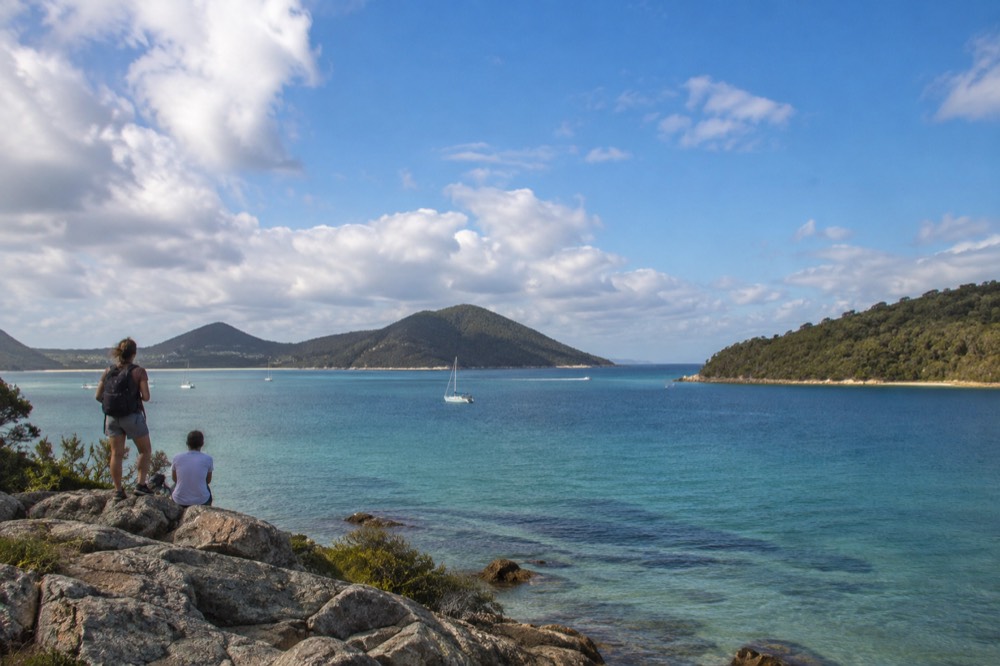
Yes, if you accept the shape of the day. Port Stephens is a genuine day trip, not a half-day excursion: the standard guided tour runs about 12 hours door to door, and independent travellers should budget a similar span once a train, a bus and the return leg are added. What you get for that is a different coastline from Sydney's, sheltered water where dolphin cruises operate, the Stockton sand dunes and quiet beaches that the city's crowds never reach.
The bay itself is the drawcard. Where Sydney's harbour is a working port wrapped in a city, Port Stephens is a holiday-town shoreline of the kind the NSW North Coast is known for: Nelson Bay as the main hub, Shoal Bay at the tip, and beaches running out toward the heads. The water is calmer than the ocean beaches, which is why the dolphin cruise is the signature activity rather than surfing.
The honest counterargument is the travel. A day trip spends a large share of its hours in a vehicle, and travellers who dislike long drives may be happier with a closer option from our day trips from Sydney roundup, where the Blue Mountains and the Royal National Park both sit inside a much shorter radius. Port Stephens rewards people who like the journey to feel like part of the outing, and who would rather watch dolphins than save an hour each way.
It also depends on the season. Between late June and July the whale migration peaks along this coast, and the same stretch of water carries both resident dolphins and passing humpbacks. In the shoulder months the cruise is still running but the headline spectacle is dolphins alone. Neither version is a disappointment, but they are different days.
How Do You Get to Port Stephens Without a Car?
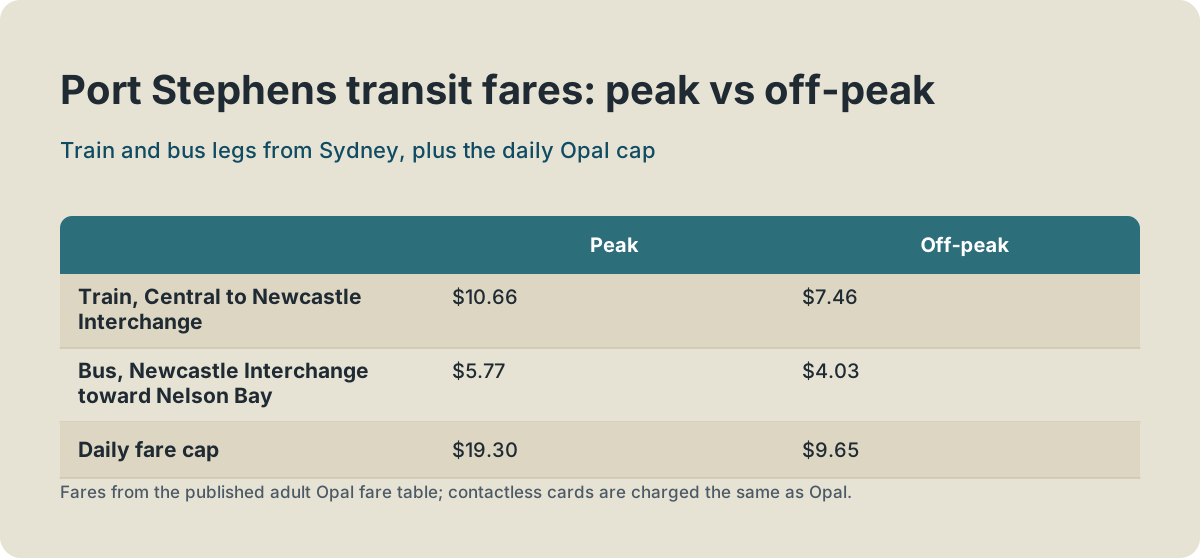
There is no direct train. The independent route is a Sydney Trains service from Central to Newcastle Interchange, then a connecting bus toward Nelson Bay, with the whole journey managed on one Opal or contactless tap. The longest distance band on the train network costs $10.66 peak or $7.46 off-peak, and the 30 percent off-peak discount applies on Fridays, weekends and public holidays.
The train leg is the easy part. Intercity services run from Sydney Central toward Newcastle, and the 65-plus-kilometre fare band covers that run: $10.66 at peak times, $7.46 off-peak, per the published adult Opal fare table. A contactless card or phone is charged exactly the same as an Opal card and earns the same caps, so overseas visitors do not need to buy a card first; our Opal card guide for visitors covers the details. Daily caps apply network-wide, which matters if you are combining this leg with other Sydney transport in one day.
The bus leg is where timing gets tight. Buses connect from Newcastle Interchange toward Nelson Bay and the bay's towns, but frequency is modest compared with Sydney's network, and a missed connection can strand you for an hour or more. Anyone going independently should plan the day around the return connection, not the outward one: the last buses of the afternoon do not wait for slow walkers.
The full set of options, with the trade-offs that matter, is laid out below.
| Way to get there | Time each way | What it costs | Main trade-off |
|---|---|---|---|
| Guided coach tour | included in tour, about 12 hours door to door | from US$91.04, cruise included | fixed itinerary, no flexibility |
| Train plus connecting bus | several hours, connection-dependent | $10.66 peak or $7.46 off-peak train leg, plus bus fare | cheap but exposed to missed connections |
| Hire car | drive at your own pace | rental plus fuel, no park entry fee at the bay | you do all the driving and navigation |
| Private transfer or rideshare | door to door | premium, varies by operator | expensive at this distance |
That friction is exactly why the guided option exists. The coach tour collects in central Sydney, drives the whole way while you sleep or watch the Hawkesbury slide past, and hands you a dolphin cruise and beach time without a single timetable to catch.
The trio above is a fair cross-section of the decision. The Port Stephens tour is the day trip this page is about; the Blue Mountains all-inclusive is the same format pointed at the nearest World Heritage escarpment; and the Opera House tour is the reminder that a one-hour city tour costs less than any of the day trips and fits a first-day itinerary. If Port Stephens is the reason you are reading, keep the first card in mind; if a 12-hour day sounds punishing, the second and third are shorter.
What Does a Port Stephens Day Trip Actually Cost?
Independent travel is cheap in fares but expensive in hours: the train leg costs $10.66 peak or $7.46 off-peak each way, the connecting bus falls in the 8-plus-kilometre band at $5.77 peak or $4.03 off-peak, and the daily cap of $19.30, or $9.65 on Fridays, weekends and public holidays, limits the damage. The guided tour costs more in dollars, from US$91.04, and buys back the entire navigation problem.
The fare maths is straightforward because Transport for NSW publishes every band. The table below shows what the independent route costs per person on each leg, before any cruise or activity on the bay.
| Leg | Fare band | Peak | Off-peak |
|---|---|---|---|
| Train, Central to Newcastle Interchange | 65+ km | $10.66 | $7.46 |
| Bus, Newcastle Interchange toward Nelson Bay | 8+ km | $5.77 | $4.03 |
Two Sydney-wide rules improve those numbers. The 30 percent off-peak discount applies to trains and buses on Fridays, weekends and public holidays, and the daily cap, $19.30 Monday to Thursday or $9.65 Friday to Sunday, means a heavy transport day stops charging after a point. Note that NSW observes daylight saving from early October to early April, so timetables shift between seasons; check the specific date rather than a memorised schedule.
What the table cannot capture is the activity cost. A dolphin cruise bought separately at the bay is a second transaction, and the sand dune experiences are another. The guided tour folds the cruise into its price and carries the live figure on its listing, so the comparison is not simply fares versus tour price; it is fares plus cruise plus navigation risk versus one number.
Dolphins and Whales: What the Water Gives You
Dolphin cruises run year-round on the bay, and whales add a second layer from May to November: humpbacks head north to breed roughly May to July, then return south with calves roughly August to November, with the peak around late June and July. NSW National Parks estimates 40,000-plus humpbacks now migrate along the NSW coast each year, a population recovery figure rather than a count of whales passing any one headland.
The guided day trip offers a dolphin cruise or a hike as its centrepiece option, which is a genuine choice rather than a formality. The cruise puts you on the water with the bay's resident dolphins; the hike option trades the boat for headland walking with views across the entrance. Families with small children usually do better on the boat; anyone who prefers solid ground and a lookout usually does better on foot.
The whale months are the bonus layer. The official migration guidance from NSW National Parks gives the season as May to November along this coast, with the southbound mothers and calves travelling closer to shore in the later months. That is the window in which a Port Stephens cruise has a chance of adding whales to dolphins, and it is also the window covered in our whale watching in Sydney guide, which compares the Sydney-based cruise options if you would rather not drive north at all.
No operator guarantees a sighting, and any tour that implies otherwise is overselling. Dolphins are the reliable half of the equation; whales are the seasonal bonus.
The Stockton Sand Dunes at Anna Bay
The Stockton sand dunes, reached through Anna Bay on the southern shore, are the largest sand dune system on the NSW coast and the reason many day trippers choose Port Stephens over closer bays. They sit on Worimi Country, and the experiences on them, from 4WD tours to sandboarding, are booked as add-ons rather than included in a standard day trip.
The dunes are the part of Port Stephens that photographs do not oversell. A landscape of rolling sand running down to the water is genuinely rare this close to a major city, and the contrast with the sheltered bay on the other side of the peninsula is the day's biggest visual swing. Tours operate on the dunes as separate products, so a day tripper choosing the guided coach option should check whether the itinerary allows time for one, or whether the dunes are a drive-past on the way to the bay. Everything else covered here is indexed on Sydney Travel Guide.
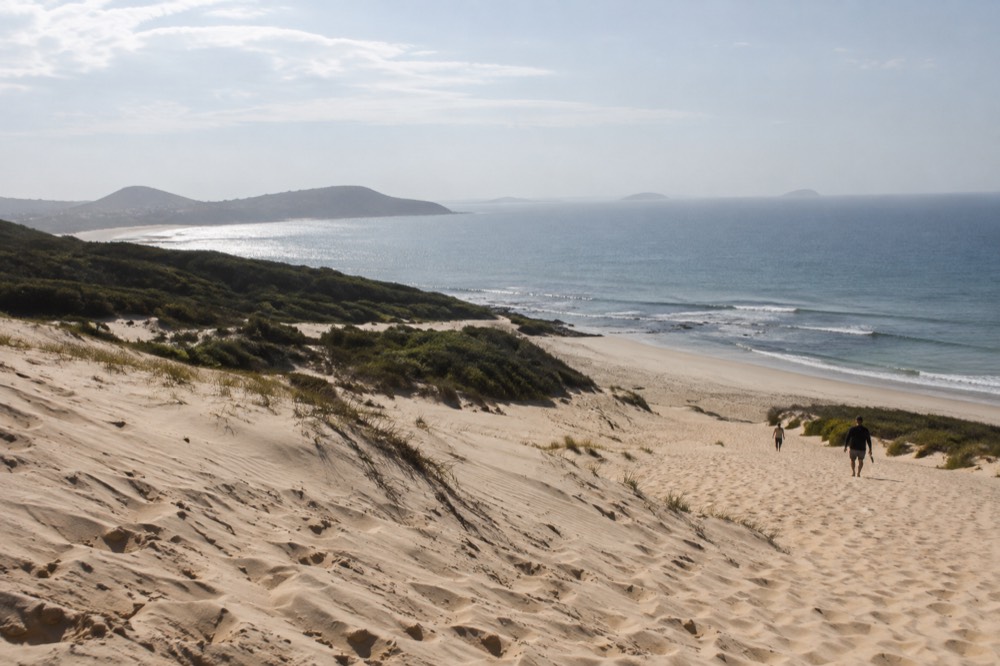
Practically, the dunes reward planning. Sandboarding and 4WD rides run on their own schedules, prices are dynamic and are quoted on the operators' own listings, and wind reshapes the experience: a still morning is a different outing from a blustery afternoon. Independent travellers with a car can reach Anna Bay directly; anyone on the train-and-bus route should treat the dunes as an optional extra that may not fit the timetable.
The cultural layer matters here too. The dunes and the surrounding lands are those of the Worimi people, and the experiences that operate on them do so on Country. Treat the area as a living cultural landscape rather than an empty playground, and follow the guidance of whatever operator you book with.
Beaches, Lookouts and the Rest of the Day
Beyond the cruise and the dunes, the day fills with the bay's small pleasures: Nelson Bay's sheltered swimming beaches, the walk up Tomaree Headland for the view over the entrance, and the low-key towns of Shoal Bay and Salamander Bay. None of these need bookings, which makes them the flexible filler around the two headline activities.
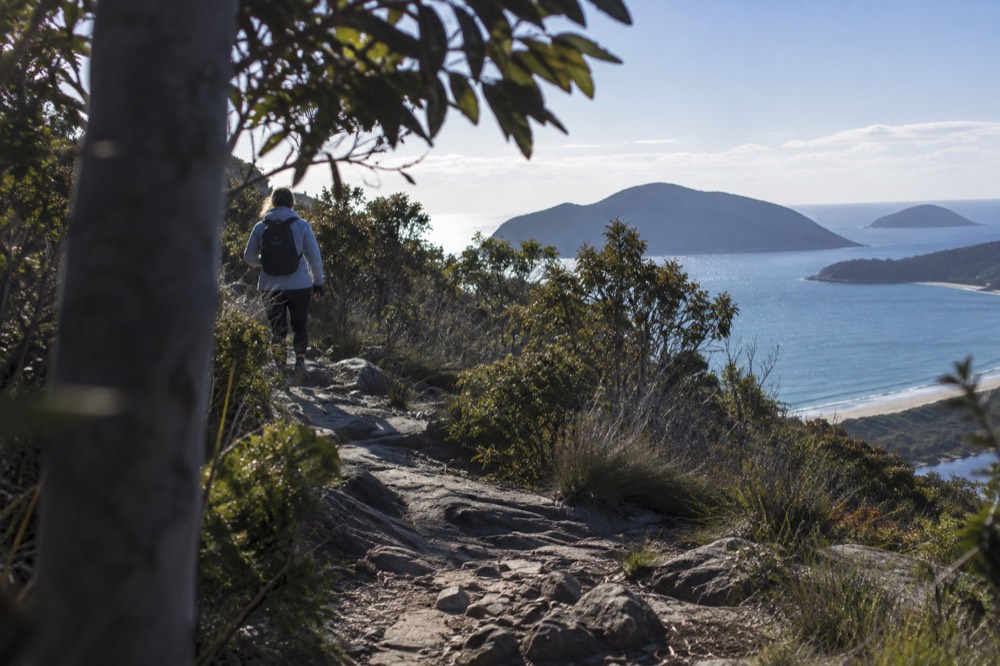
Tomaree Headland is the walk people remember. The track climbs the headland that guards the bay's ocean entrance, and the summit looks back across the water to the towns and out to sea. It is the best free thing to do between the cruise and lunch, and it doubles as a land-based whale-watching spot in season, though sightings from any headland are a matter of luck and patience.
The beaches split by mood. The bay-side beaches inside the harbour are calm and family-friendly, with water gentle enough for weak swimmers; the ocean beaches outside the heads carry surf and require the usual caution. Swim at patrolled locations and between the flags where a patrol is running, and check conditions on the day rather than assuming. Our best beaches in Sydney guide covers the patrol-season logic that applies on this coast too.
The day's moving parts, in one view:
| Activity | Where | Needs booking | Best time of day |
|---|---|---|---|
| Dolphin cruise | Nelson Bay marina | yes, or via the guided tour | morning, before the sea breeze |
| Tomaree Headland walk | Tomaree Headland | no | mid-morning or late afternoon light |
| Stockton sand dunes | Anna Bay | yes, separate operators | morning, cooler sand |
| Bay-side swimming | Nelson Bay and Shoal Bay | no | midday, warmest water |
| Fish and chips | Nelson Bay foreshore | no | whenever the cruise ends |
If wildlife rather than water is the point of your trip, it is worth knowing the alternatives before you commit a full day to Port Stephens. A wombat and kangaroo day tour runs about 10 hours 30 minutes from Sydney and is built entirely around guaranteed animal sightings, which a dolphin cruise cannot promise.
Where to Eat and What to Pack
Pack for two climates in one day: the bay is sheltered and calm, the dunes are exposed sand, and the headland walk is a real hill. Eat around Nelson Bay's marina strip, where the seafood is local and the fish and chips tradition is taken seriously. Bring a windproof layer even in summer; the water keeps the air cooler than Sydney's, and boat decks move fast.
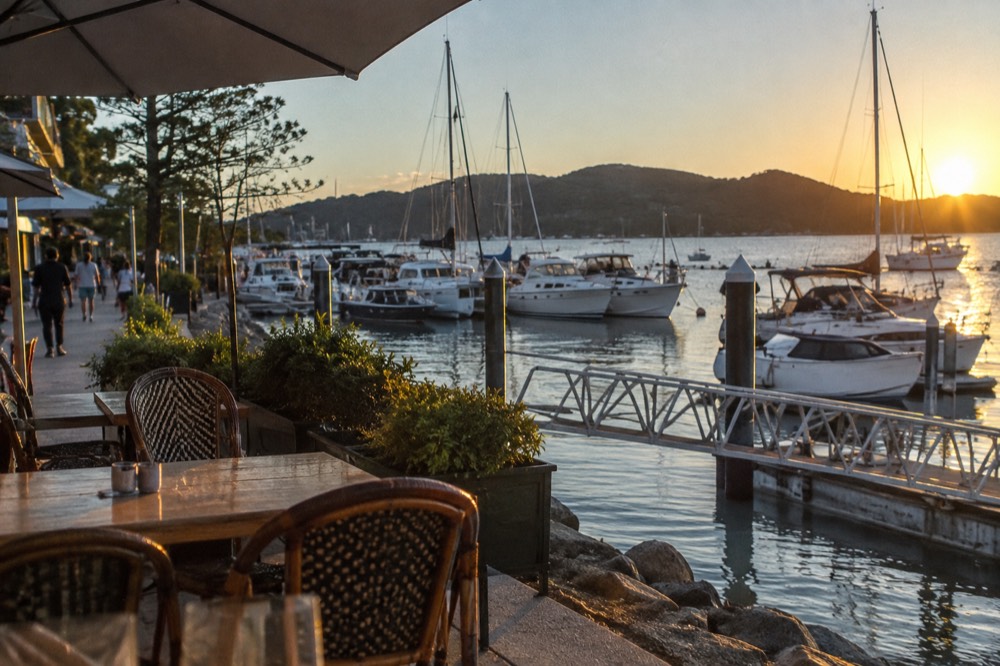
The food is the easy part. Nelson Bay's foreshore is lined with the standard Australian coastal repertoire, cafes for breakfast, a bakery or two, and fish and chips near the marina where the boats come in. The new Sydney Fish Market gets the headlines back in the city, and our Sydney food guide covers that end, but a day trip here runs on simple waterfront meals rather than destination dining. Book nothing, and eat when the cruise ends.
The packing list is short but specific. Sun protection is non-negotiable: NSW UV levels pass the protection threshold for most of the year, and a boat deck plus a dune field is a full day of exposure. Sea-sickness tablets if the ocean swell is running, because the whale-season cruises that leave the bay's shelter can pitch. Enclosed shoes for Tomaree, because the track is steep and sandy in sections. And cash-free is fine; card payment is normal everywhere in NSW.
One transport note for the return: if you are on the train, tap on and tap off every time, or the system charges a default fare. It is the single most common way visitors overpay on NSW transport.
When to Go: Months, Whales and Weather
Go between May and November for the chance of whales on top of dolphins, with late June and July the visible peak of the migration. For warm swimming weather, December through February is summer here, but the whale season has ended by then and the bay is at its busiest. Shoulder months, autumn and spring, split the difference with quieter water and thinner crowds.
The seasonality is the part most Sydney itineraries get wrong, because the northern-hemisphere instinct is to assume marine wildlife watching is a summer activity. On this coast it is the opposite: the humpback migration runs May to November, so a winter day trip has a chance of a sighting that a February day trip does not. Dolphins carry the summer months on their own.
| Period | What is in the water | Crowd level | Verdict |
|---|---|---|---|
| December to February | dolphins only, whale season over | busiest, school holidays | best for swimming, not whales |
| March and April | dolphins, migration begins late in the window | quiet | good value shoulder pick |
| May to July | dolphins plus northbound humpbacks | moderate | whale season opens, peak late June to July |
| August to November | dolphins plus southbound mothers and calves | moderate to quiet | best whale odds, calm bays |
| Late June and July | migration peak | moderate | the single best wildlife window |
Weather-wise, Sydney's own climate data holds a surprise that applies to the whole region: June is statistically Sydney's wettest month, wetter than any summer month, while August has the most clear days of the year. A winter day trip is not the gamble visitors assume. Our best time to visit Sydney guide unpacks the month-by-month numbers, and the Sydney weather month by month page carries the full table.
One timing rule for the tour itself: book the dolphin cruise day for a morning start if the option exists, because the bay is at its calmest before the afternoon sea breeze fills in, and a calm deck is the difference between spotting dolphins and staring at whitecaps.
Guided Day Tour or Independent Trip: Which Suits You?
Take the guided tour if you want the dolphin cruise, the dunes and the drive handled in one booking and one 12-hour day. Go independent if you want to set your own pace, spend the fare difference on a longer lunch, or break the journey in Newcastle. Families, first-time visitors and anyone without a car should lean guided; confident travellers with a spare day should lean independent.
The guided case is mostly an arithmetic case. The tour runs about 12 hours, includes the cruise-or-hike choice, and removes every connection risk described in the transport section above. The trade is control: you eat where the tour eats and leave when the coach leaves.
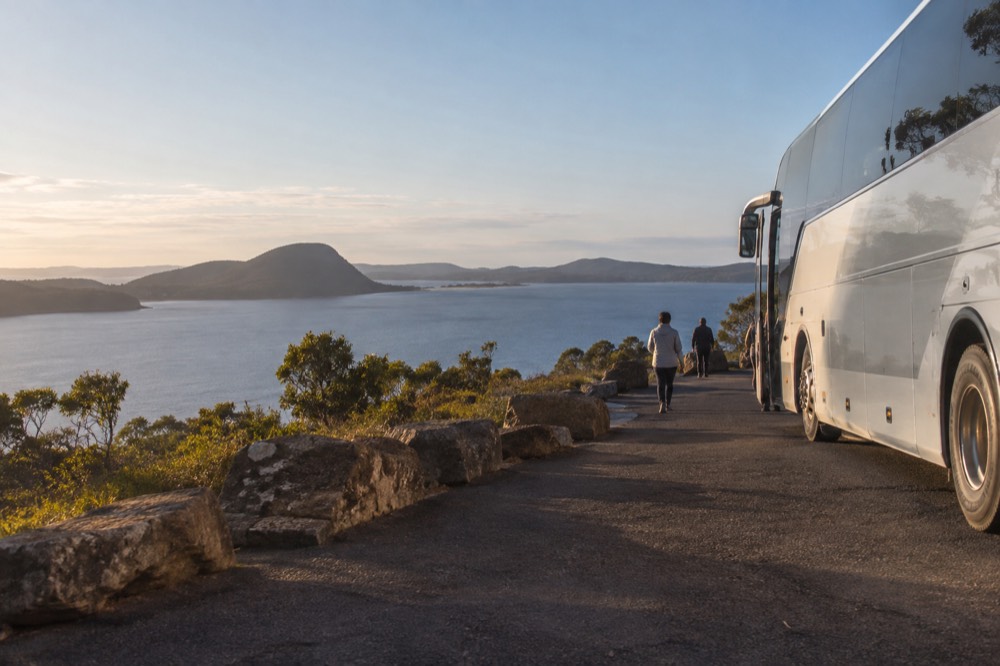
The independent case is mostly a freedom case. With a hire car, the whole peninsula opens up, from the dunes to the heads to the quiet corners a coach cannot reach, and the fare maths from the cost table above shows how cheap the public-transport version is. The trade is time and attention: you are the one watching the clock for the last bus.
If your real goal is simply "dolphins near Sydney" rather than Port Stephens specifically, there is a shorter-listed alternative worth naming. A Jervis Bay day trip from Sydney also runs about 12 hours and includes dolphins, kangaroos and beach time, pointing south instead of north.
Whichever way you go, two rules hold. Book the cruise, or the tour that contains it, before you leave Sydney, because peak-season boats fill; our how far in advance should you book Sydney tours piece covers the general logic. And do not plan a second big activity for the same evening; a Port Stephens day ends where you started it, tired, and the best thing to book after it is dinner within walking distance. For more options in every direction, see the full day trips from Sydney without a car guide.
Common Questions About a Port Stephens Day Trip
How far is Port Stephens from Sydney?
Far enough that every way of doing it is a full-day commitment. The guided tour runs about 12 hours door to door, and the independent train-and-bus route takes a comparable span once connections are included. Treat it as the longest of Sydney's standard day trips and plan nothing else for the day.
Can you see dolphins at Port Stephens all year?
Dolphin cruises operate on the bay year-round, and the guided day trip offers a cruise or a hike as its centrepiece. No operator guarantees a sighting, but dolphins are the reliable half of the bay's marine life. Whales are the seasonal bonus, running May to November with the peak around late June and July.
Can you do Port Stephens by public transport?
Yes. A train from Sydney Central to Newcastle Interchange, then a connecting bus toward Nelson Bay, covers the whole route on one Opal or contactless tap. The fare maths is cheap, but bus frequency toward the bay is modest, so plan the day around the return connection rather than the outward one.
Is Port Stephens or Jervis Bay the better day trip?
They are close cousins: both run about 12 hours from Sydney, both centre on dolphins, and both add beach time. Port Stephens points north and adds the Stockton sand dunes; Jervis Bay points south and adds kangaroos and the whitest-sand beach tradition. Choose on drive preference and season, not on the wildlife, which is similar.
What is the best month for a Port Stephens day trip?
For whales on top of dolphins, go between May and November, with late June and July the migration peak. For warm swimming weather, December through February is summer, but the whale season has ended and crowds peak. Autumn and spring split the difference with quieter water and thinner crowds.
Is the Stockton sand dunes visit included in the day trip?
The dune experiences at Anna Bay, including 4WD tours and sandboarding, are separate products with their own dynamic pricing, not part of a standard dolphin cruise day trip. Check whether your itinerary allows time for one before booking, or plan the dunes for a future trip with a car.