The Best Day Trips from Sydney: Blue Mountains, Hunter Valley and the Coast
Sydney keeps a whole second holiday within two hours of its CBD: mountain lookouts, wine country, dolphin beaches and national parks, most of them reachable by train or tour bus. Here is how the main options compare on time, cost and season.
Short answer
The best day trips from Sydney are the Blue Mountains, about two hours west by train from Central Station, the Hunter Valley wine region, Royal National Park, the South Coast towns of Kiama and Wollongong, and Port Stephens for dolphins. Most cost under A$50 in transport if you use Opal, and the Blue Mountains National Park itself charges no entry fee outside Glenbrook.
What Are the Best Day Trips from Sydney?
The strongest day trips from Sydney are the Blue Mountains, the Hunter Valley, Royal National Park, the Kiama and Wollongong coast, Port Stephens, and Jervis Bay. All sit within roughly three hours of the CBD. The Blue Mountains and the South Coast are reachable by train on an Opal card, the Hunter Valley and Port Stephens are far easier by tour or car, and Royal National Park works best with a vehicle. Most visitors fit two or three of these into a week-long stay.
Sydney's geography is unusually generous. The Great Dividing Range begins a commuter train ride to the west, the Hunter Valley's vineyards sit two hours north, and the coastline south of the city runs through two national parks before it reaches dairy country and white-sand bays. You never need to book a flight or pack an overnight bag to reach any of it.
The choice usually comes down to three questions. Do you want mountains, wine, or water? Are you driving, or are you on public transport? And what season is it, because June and July suit the Blue Mountains differently than February does. This guide answers each of those, with real fares and real travel times rather than vague promises.
Start with the short version. The table below lists the headline day trips, their direction from the city, and the honest minimum time each one deserves. Anything under eight hours round trip is comfortable as a day trip; anything longer works, but you will feel the drive.
| Day trip | Direction | Transport reality | Realistic day length |
|---|---|---|---|
| Blue Mountains (Katoomba) | West | Direct train, ~2 hours from Central | 8-10 hours |
| Royal National Park | South | Short drive to the park edge | 6-8 hours |
| Wollongong and Sea Cliff Bridge | South | Direct train | 7-8 hours |
| Kiama blowhole | South | Direct train | 8-9 hours |
| Hunter Valley | North | Tour or car, no practical train | 10-11 hours |
| Port Stephens | North | Tour or car | 12 hours |
| Jervis Bay | South | Tour or car | 12 hours |
| Canberra | South-west | Train or coach, longest day here | 12 hours 30 minutes |
Each of these has a full guide of its own on this site. For depth on a single destination, see the Blue Mountains day trip guide, the Hunter Valley day trip guide, and the Royal National Park guide. This page is the comparison layer: which one, when, and how.
Which Day Trips from Sydney Work Without a Car?
The Blue Mountains, Wollongong, Kiama and Canberra are all genuinely car-free, because a train line reaches them. Katoomba is about two hours from Central Station and the Opal fare from the CBD sits in the 35-65 km band. The Hunter Valley, Port Stephens and Jervis Bay have patchy or no direct public transport, so a tour or a hire car is the practical answer there. Roughly half of Sydney's best day trips are train trips.
The train network does more heavy lifting here than most visitors expect. The Blue Mountains Line runs from Central to Katoomba and beyond, the South Coast Line reaches Wollongong, Kiama and (with a change) Port Kembla, and the Southern Highlands towns of Mittagong and Bowral sit on the same corridor toward Canberra. A full breakdown of which destinations the trains serve, with fares, is in day trips from Sydney by train.
Fares are distance-based and capped. An adult Opal trip from the CBD to Katoomba is charged in the 35-65 km band, and the daily cap means a big day out rarely costs more than A$19.30 on a weekday, or A$9.65 on a Friday, weekend or public holiday. Contactless cards and phones are charged exactly the same as an Opal card and earn the same caps, so there is no need to buy a card for a single day trip. Transport for NSW publishes the full adult fare and cap tables.
| Destination | Direct train? | Line | Notes for visitors |
|---|---|---|---|
| Katoomba (Blue Mountains) | Yes | Blue Mountains Line | ~2 hours from Central |
| Wollongong | Yes | South Coast Line | ~90 minutes, views over the Illawarra escarpment |
| Kiama | Yes | South Coast Line | ~2 hours; blowhole a short walk from the station |
| Mittagong / Bowral | Yes | Southern Highlands Line | ~2 hours; Bowral station a short walk to town |
| Newcastle | Yes | Central Coast Line | ~2.5 hours; change at Hamilton for further north |
| Hunter Valley (Cessnock/Pokolbin) | No | Change at Singleton, then bus | Impractical; tour or car is the norm |
| Port Stephens | No | Train to Hamilton, then bus | 3+ hours door to door |
| Jervis Bay | No | Train to Bomaderry, then bus | Doable but slow; tours exist |
The car-free gap is where tours earn their keep. A guided day trip to the Hunter Valley or Port Stephens costs more than a train ticket, but it removes a two- or three-leg public transport journey and usually bundles lunch or a cruise. If you are weighing the trade-off, the day trips from Sydney without a car guide walks through it in detail.
For a first taste of what a guided day looks like, these three are the strongest all-round picks: the Blue Mountains all-inclusive, a wildlife-and-wine loop, and, for a half-day option in the city itself, the Opera House tour that anchors most Sydney itineraries.
What Do Day Trips from Sydney Actually Cost?
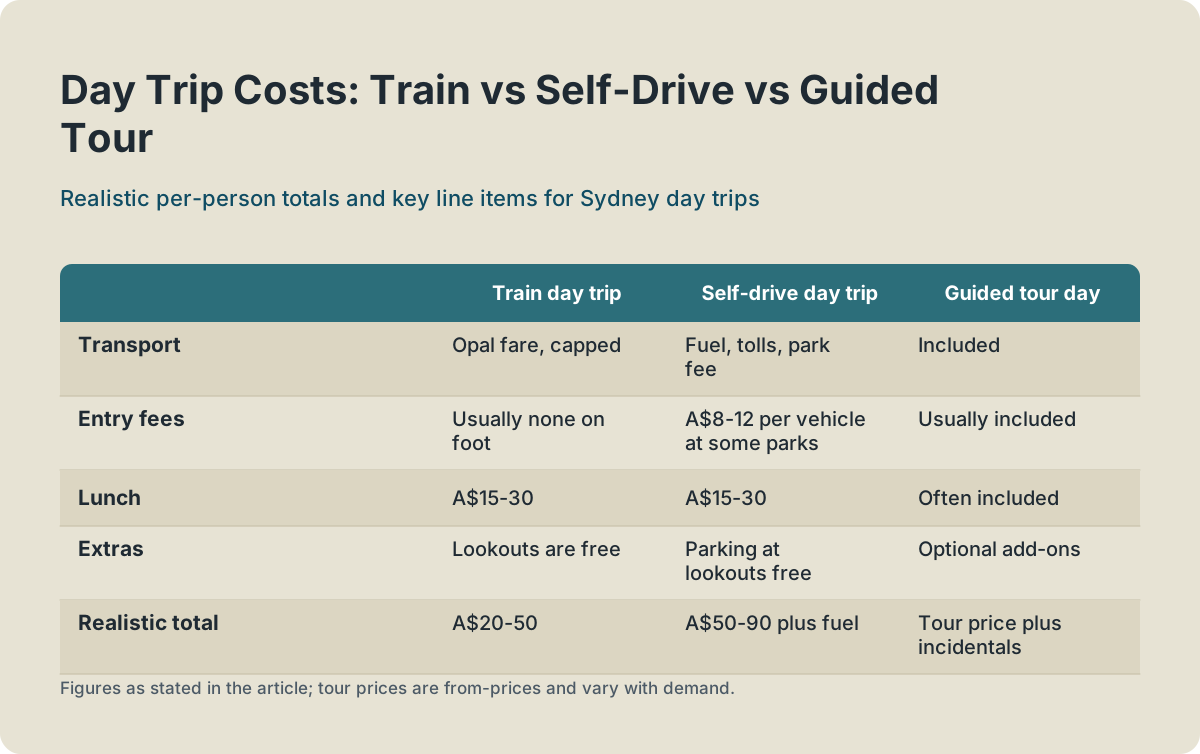
Budget A$20-50 per person for a train-based day trip including fares and food, and expect a guided tour with transport included to cost more than any self-directed version. The Blue Mountains National Park charges no entry fee outside the Glenbrook area, Royal National Park is A$12 per vehicle per day, and Opal daily caps mean a Friday, weekend or public holiday day trip costs at most A$9.65 in fares. Tour prices are from-prices and vary by season.
The cheapest version of almost every day trip is the train version. A Katoomba return, a wander to Echo Point, and a bakery lunch can be done for well under A$50. What you give up is the stuff between the stations: the lookouts that need wheels, the cellar doors with no bus stop, the beaches at the end of unsealed roads.
National park fees are the line item most visitors forget. NSW National Parks charges per vehicle, not per person, and only at fee-collecting parks. Royal National Park is A$12 per vehicle per day; the Blue Mountains National Park is A$8 per day but only in the Glenbrook area, meaning Katoomba, Blackheath and Wentworth Falls cost nothing to enter. The official park fees page lists every fee-collecting park in the state. Arriving by train or on foot avoids vehicle fees almost everywhere.
| Cost item | Train day trip | Self-drive day trip | Guided tour day trip |
|---|---|---|---|
| Transport | Opal fare, capped | Fuel, tolls, park fee | Included |
| Entry fees | Usually none on foot | A$8-12 per vehicle at some parks | Usually included |
| Lunch | A$15-30 | A$15-30 | Often included |
| Extras | Lookouts are free | Parking at lookouts free | Optional add-ons |
| Realistic total | A$20-50 | A$50-90 plus fuel | Tour price plus incidentals |
Guided tours are from-prices and move with demand, so treat any figure you see on a listing as the floor, not the quote. What a good tour buys you is a driver-guide who knows which lookout has a car park at 10am and which one does not, and a schedule that fits more into a day than a first-time visitor could plan alone.
If the Blue Mountains is your pick and you would rather not plan the day at all, the all-inclusive small-group option below covers transport, the lookouts and lunch in a single booking.
Is the Blue Mountains the Best Day Trip from Sydney?
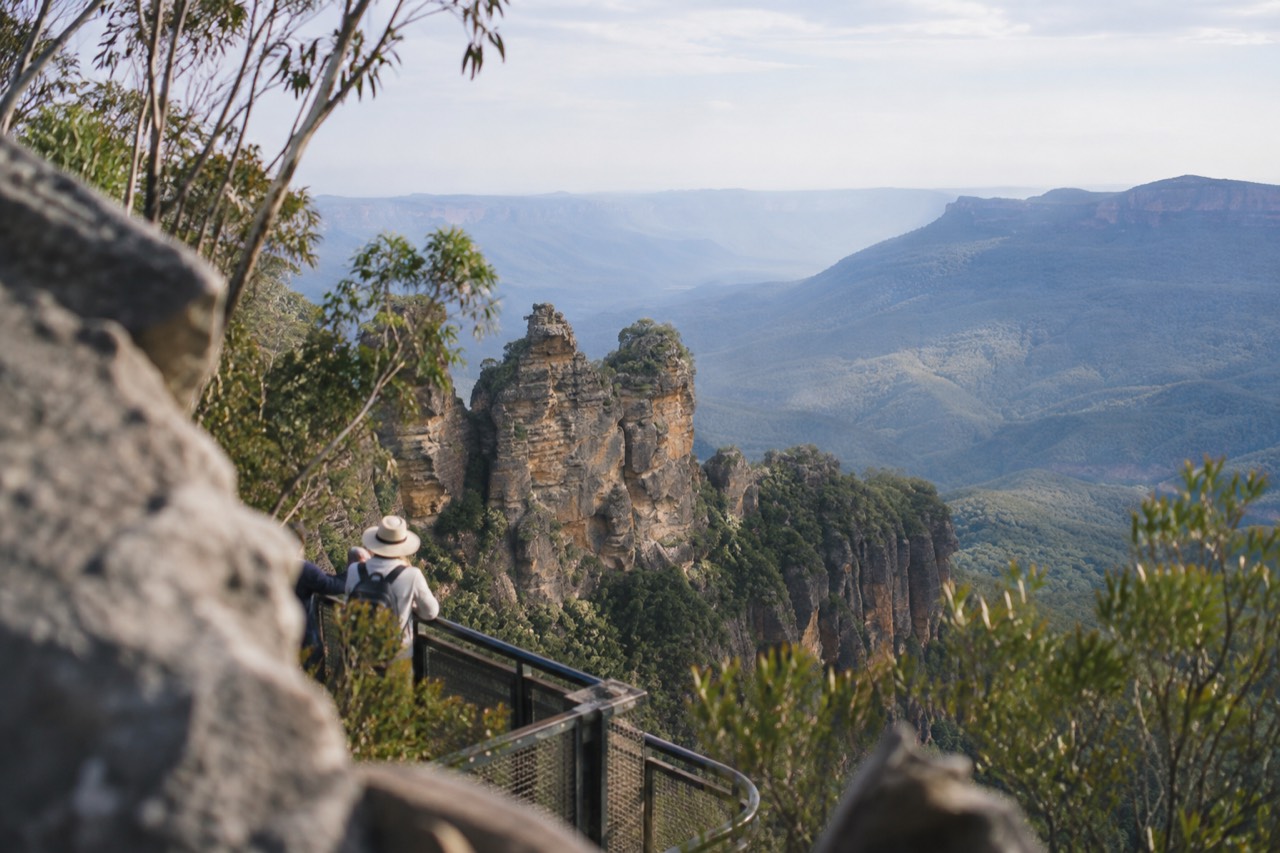
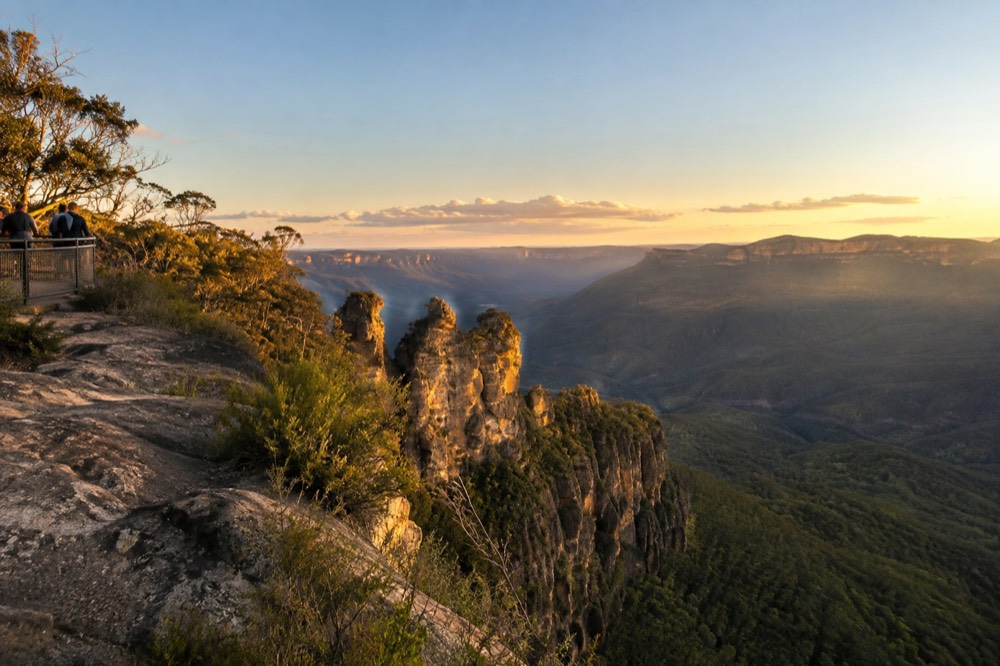
For most first-time visitors, yes. The Blue Mountains combines a two-hour train ride, free entry to the national park outside Glenbrook, and a concentration of lookouts, waterfalls and walks that no other Sydney day trip matches. Echo Point and the Three Sisters are about a 15-minute walk from Katoomba station, which makes the whole day possible without a car, a tour or even much planning.
The mountains earn their name honestly: the haze across the valleys comes from eucalyptus oil in the forest, and the blue is real rather than a marketing invention. Katoomba is the practical base, with Echo Point, Scenic World and the start of several walking tracks all within reach of the station. Leura, one stop away, is the prettier town for lunch and shops; the Katoomba and Three Sisters guide covers the layout.
Two honest caveats. First, the mountains sit noticeably higher and colder than the CBD, so winter days bite: the long-run July average maximum in Sydney is 16.4 °C, and Katoomba runs several degrees cooler than the city, with occasional snow. Second, the area carries track and road closures through late 2026, including Mount Hay Road and parts of the Federal Pass track, so check the NPWS alerts page before locking in a walk.
The train version of the day costs a capped Opal fare and nothing else. The tour version buys you the lookouts between Katoomba and Blackheath that trains skip, plus a guide. The all-inclusive small-group tour below is the strongest of those, with transport, lunch and the main sights in one price.
Is the Hunter Valley Worth a Day Trip?
Yes, if wine or food is the point of your day, and if you accept that it is the one headline destination where a tour or a car is close to mandatory. The Hunter Valley sits roughly two hours' drive north of Sydney, and cellar-door tasting fees typically run A$5-20 per person at the room. A guided wine tour with lunch included is the relaxed way to do it in one day.
The Hunter is Australia's oldest wine region, and its two signature grapes, semillon and shiraz, are the reason it holds a place on itineraries. Pokolbin, the main cellar-door belt, is a spread of roads and driveways with no train station and limited buses, which is why the Hunter Valley day trip guide is blunt about transport: tour or drive.
Tasting fees are a planning range, not a promise. Many cellar doors waive the fee on purchase, some charge per tasting flight, and a few of the big names take bookings only. Lunch in the valley runs from bakery-level to fine dining, and the better tour operators hold restaurant bookings you could not get as a walk-in on a Saturday.
The wildlife, waterfalls and wine day tour below splits the difference nicely: it is a longer loop than a straight wine tour, but it suits travellers who want animals and scenery along with the cellar doors rather than a full day of tasting.
Which Day Trips from Sydney Are Best for Beaches and Wildlife?
Port Stephens, Jervis Bay and the Royal National Park are the standouts. Port Stephens runs dolphin cruises on sheltered water, Jervis Bay has some of the whitest sand measured in Australia and its own dolphin population, and Royal National Park packs cliff walks and swim spots into a short drive from the city. Whale watching from Sydney runs May to November, so the coast day trips change character with the season.
Port Stephens, a long drive north, is the classic dolphin day: a cruise on the bay, sand dunes at Stockton, and time for lunch at Nelson Bay or a walk up Tomaree Headland. The Port Stephens day trip guide covers the trade-off honestly, because this is a 12-hour day and the drive home is long.
Jervis Bay flips the same formula south, with Hyams Beach, dolphin cruises from Huskisson and kangaroos on the grounds around the settlement. It is also a 12-hour day by tour, and the Jervis Bay day trip guide explains why the guided version beats a self-drive for most visitors.
Royal National Park is the one you can do in half a day. The Coast Track, the Figure Eight Pool and Wattamolla are the famous stops, and the whole park sits just south of the city. Two safety notes carry real weight here: swim only at patrolled beaches between the red and yellow flags, and stay out of the water for up to three days after heavy rain at harbour and estuary sites, or one day at ocean beaches, per the official Beachwatch advice.
The Jervis Bay tour below is the strongest wildlife-and-water day trip on the roster: dolphins, kangaroos and beach time in a single guided day.
What About the South Coast and the Southern Highlands?
The South Coast day trip runs Wollongong, the Sea Cliff Bridge and Kiama, all on one train line, and the Southern Highlands offers Bowral and Mittagong on the same corridor. Kiama's blowhole is a 15-minute walk from its railway station, which makes it the easiest headline attraction of any Sydney day trip. Both trips are under two hours by train and cost a capped Opal fare.
The South Coast Line is the sleeper hit of Sydney's day-trip network. The track descends the Illawarra escarpment between coal cliffs and the sea, and the Sea Cliff Bridge section, where the road and rail hug the cliff face, is the postcard moment. Wollongong itself is a real city with a beach, a lighthouse and a botanic garden, and the Wollongong and Sea Cliff Bridge guide covers the stops.
Kiama adds the blowhole, which performs best with a south-east swell, and a small-town main street a short walk from the station. The Kiama blowhole guide covers the swell logic, because arriving on a flat day is the classic Kiama disappointment.
The Southern Highlands, one stop further inland, is a cooler-climate alternative: Bowral's gardens, bookshops and cold winters make it feel like a different trip entirely, and it is the same train line toward Canberra. If a capital-city day appeals, the Canberra day trip guide explains what a 12-hour-plus day to the national institutions actually looks like.
When Is the Best Season for Day Trips from Sydney?
There is no bad season, but each suits a different trip. The Blue Mountains is at its clearest in August, which has the most clear days of any month in Sydney's long-run record, while February is the cloudiest month of the year despite being peak summer. June is Sydney's wettest month at 133.1 mm on average, wetter than any summer month. Whale season runs May to November, with the southern migration, whales close to shore with calves, from August to November.
The counterintuitive part is worth sitting with. Peak tourist season in Sydney is December to February, and February is statistically the city's cloudiest month, with 5.3 clear days on the long-run average against August's 13.4. A visitor who books a February trip for "reliable sunshine" has picked the least clear-sky month on the calendar. The Bureau of Meteorology's Sydney climate averages hold the full table.
| Season (months) | Best day trips | Watch out for |
|---|---|---|
| Summer (Dec-Feb) | Beaches, Jervis Bay, Port Stephens | Cloudiest skies of the year; UV extreme at 11+; crowds |
| Autumn (Mar-May) | Hunter Valley, Blue Mountains | March and April are wet months on average |
| Winter (Jun-Aug) | Blue Mountains, whale watching | June is the wettest month; Katoomba is cold |
| Spring (Sep-Nov) | Whale season, Southern Highlands, all trips | October heat can arrive early |
Two seasonal mechanics matter beyond the averages. Daylight saving runs from the first Sunday in October to the first Sunday in April, so an October-to-March day trip has evening light until past 7pm, while a July day trip has daylight gone by 5pm and a long drive home in the dark. And whale season, May to November, means the coastal trips have a second attraction for more than half the year; the whale watching guide covers the migration windows.
Bush fire danger also has a calendar. The statutory danger period runs 1 October to 31 March, and while Sydney itself is far from cyclone country, a hot, windy October day in the mountains is a day to check alerts before you go.
How Do You Choose Between Sydney's Day Trips?
Pick by theme first, transport second, season third. Mountains and lookouts point to the Blue Mountains; wine and food point to the Hunter Valley; beaches, dolphins and wildlife point to Port Stephens or Jervis Bay; and a car-free budget points to anything on a train line. If you have only one day free and no strong preference, the Blue Mountains is the default answer, because it combines the strongest scenery with the easiest logistics.
The honest ranking for a single day, for most travellers, runs roughly: Blue Mountains first, then a South Coast train day, then Jervis Bay or Port Stephens by tour, then the Hunter Valley, then the Southern Highlands. But that ranking assumes clear weather, and the climate table above says August and July deliver clear skies more reliably than February does. On a wet June weekend, the rainy day itinerary beats any of them.
For a longer stay, this site's itinerary guides stack day trips sensibly: 3 days in Sydney keeps you in the city, 4 days in Sydney adds one day trip, and 5 days in Sydney fits two. The how many days do you need in Sydney guide makes the case that day trips are the difference between a good Sydney trip and a great one.
If you are booking tours rather than driving, the same three picks that opened this guide are the ones to compare: the Blue Mountains all-inclusive for the classic day, the wildlife-and-wine loop for variety, and the Opera House tour for the day you stay in the city.
Common Questions About Day Trips from Sydney
What is the best day trip from Sydney?
For most visitors, the Blue Mountains. It combines a roughly two-hour train ride from Central Station, free national park entry outside Glenbrook, and the densest concentration of lookouts and walks of any destination within day-trip range. Echo Point and the Three Sisters are walkable from Katoomba station, so the day works with no car and no tour.
Can you do a day trip from Sydney without a car?
Yes, for about half the headline destinations. The Blue Mountains, Wollongong, Kiama and the Southern Highlands all sit on train lines, with Opal fares capped at A$19.30 on weekdays and A$9.65 on Fridays, weekends and public holidays. The Hunter Valley, Port Stephens and Jervis Bay are far easier by guided tour or [hire car](https://discovercars.tpk.ro/FvKIyzXW).
How far in advance should you book Sydney day trip tours?
Popular small-group tours, especially Blue Mountains and Hunter Valley options, sell out on weekends and school holidays, so book a week or more ahead in peak periods. Train-based day trips need no booking at all, and national park entry is paid on arrival or via the Park'nPay app.
Is the Blue Mountains or the Hunter Valley better for a day trip?
The Blue Mountains suits scenery, walking and photography, and it is reachable by train. The Hunter Valley suits wine and food, but it has no practical train access, so you will take a tour or drive. If your day is about views, choose the mountains; if it is about tasting rooms and long lunches, choose the Hunter.
What is the cheapest day trip from Sydney?
A train trip. Kiama or Wollongong costs a capped Opal fare, the blowhole at Kiama is free and a short walk from the station, and the Blue Mountains charges no park entry fee outside Glenbrook. With a bakery lunch, a full day out can come in under A$50 per person.
When can you see whales on a day trip from Sydney?
Whale watching runs May to November along the NSW coast. The northern migration peaks around late June and July, and the southern migration, when whales travel close to shore with calves, runs August to November. Cruises depart Sydney itself, so whale watching can be a half-day rather than a full day trip.
Planning day trips is where a Sydney itinerary stops being a city break and starts being a region, and the rest of this Sydney Travel Guide covers each destination in the depth this page only sketches.