Day Trips from Sydney Without a Car: Trains, Ferries and Tours That Do the Driving
You do not need a car to leave Sydney for the day. The intercity train network reaches the Blue Mountains, the Central Coast, Wollongong and Kiama, ferries cross the harbour, and organised tours cover everything the rails miss.
Short answer
Sydney's train network reaches the Blue Mountains in about two hours from Central, Kiama in about two and a quarter hours, and Wollongong in around 90 minutes. Opal caps apply to all of it, so a Friday or weekend day trip costs at most A$9.65 in fares. Tours from around US$57 cover the destinations trains cannot reach, including the Hunter Valley and Jervis Bay.
Sydney is one of the few Australian cities where being car-free costs you almost nothing. The intercity rail network runs west to the Blue Mountains, south to Wollongong and Kiama, and north to the Central Coast and Newcastle, all on the same Opal and contactless system you use in the city. Add the ferry wharves at Circular Quay and a healthy roster of organised day tours, and the list of destinations genuinely closed to you is short: a handful of vineyard back roads and a few lookouts at the end of gravel tracks.
This guide lays out the car-free options destination by destination, with the fares, the travel times and the honest cases where a tour beats a train. If you are still deciding how many days to spend in the city at all, start with our how many days you need in Sydney guide, then come back here to plan the escape.
Which Day Trips from Sydney Actually Work Without a Car?
The realistic car-free list is longer than most visitors expect: the Blue Mountains, the Royal National Park, Wollongong, Kiama, the Central Coast, Newcastle, Parramatta and the Hawkesbury are all reachable by scheduled public transport in under about two and a half hours. The Hunter Valley and Jervis Bay are the two popular destinations where a train alone will not finish the job, and a tour or a connecting bus fills the gap. Everything on the list is doable in one day.
The dividing line is simple. If a destination sits on the intercity rail spine, you can do it yourself cheaply and on your own clock. If it sits behind a vineyard gate or down a national park fire trail, an organised tour is not a luxury, it is the only scheduled way in. That is why this guide treats tours as a transport category rather than a splurge.
The table below is the short version. Travel times are from Central station and are typical scheduled runs, not door-to-door promises.
| Destination | Best car-free option | Typical time from Central | One-way adult fare |
|---|---|---|---|
| Blue Mountains (Katoomba) | Intercity train, direct | About 2 hours | A$8.28 peak / A$5.79 off-peak |
| Wollongong | Intercity train | About 1 hour 30 minutes | A$8.28 peak / A$5.79 off-peak |
| Kiama | Intercity train | About 2 hours 15 minutes | A$10.66 peak / A$7.46 off-peak |
| Royal National Park | Train to Cronulla, then ferry to Bundeena | About 1 hour 45 minutes total | Two Opal taps, capped |
| Central Coast (Gosford) | Intercity train | Roughly 1 hour 15 minutes | A$8.28 peak / A$5.79 off-peak |
| Newcastle | Intercity train | About 2 hours 30 minutes | A$10.66 peak / A$7.46 off-peak |
| Hunter Valley | Tour or train plus connecting bus | Half a day each way | Tour price covers it |
| Jervis Bay | Tour, or train plus bus via Nowra | About 3 hours each way | Tour price covers it |
Those train fares are the standard adult Opal distance bands published by Transport for NSW, and they apply equally whether you tap an Opal card or a contactless credit card. We have a full breakdown in the Opal card guide for visitors, including the caps that matter most to a day tripper.
Is the Blue Mountains Doable by Train, and Is the Train Enough?
Yes, and mostly. Katoomba is about two hours from Central on a direct intercity train, and from Katoomba station the Explorer bus link, the Scenic World cableway and a compact walkable town centre put the Three Sisters, Echo Point and the major lookouts within reach without any car at all. The train is enough for a first visit. A tour adds value mainly when you want Scenic World, Featherdale Wildlife Park and a guided bushwalk squeezed into one day.
The Blue Mountains line is the classic Sydney day trip and the one the railway was effectively built for. Trains run from Central through Parramatta and Penrith up the sandstone escarpment to Katoomba, Leura, Wentworth Falls and Blackheath, and the scenery starts well before you arrive. Sit on the left-hand side heading west for the first views over the Nepean plain.
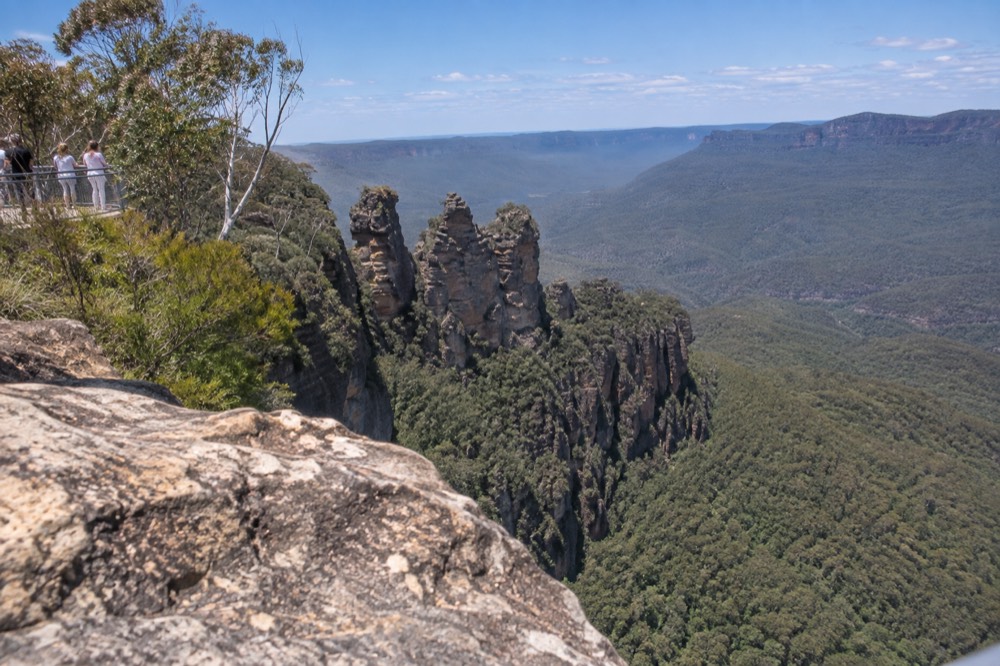
One budget fact surprises almost everyone: entry to the Blue Mountains National Park is free almost everywhere. The National Parks and Wildlife Service charges a vehicle fee only in the Glenbrook area, so as a train or bus passenger you pay nothing to stand at Echo Point or walk the cliff tracks. The details are on the NPWS fee-collecting parks page. Scenic World is a separate, privately operated attraction and is ticketed separately.
For a deeper dive into the region itself, our Blue Mountains day trip guide covers the towns, the walks and where the Three Sisters lookout fits into a day. If you would rather not run the timetable yourself, the all-inclusive small-group option below picks up in the city, covers Scenic World and Featherdale, and handles every connection:
If you are weighing the two approaches, the honest comparison looks like this.
| Approach | Cost beyond fares | What you get | Best for |
|---|---|---|---|
| Train plus Explorer bus link | A few dollars in bus fares | Full control of timing, cheap, scenic ride up the mountain | Independent travellers, repeat visitors |
| Small-group all-inclusive tour | Tour price, nothing extra | Scenic World, Featherdale, lunch, guide, hotel pickup | First-timers, families, one-day-only itineraries |
| Train plus self-guided walking | Fares only | Free park entry, cliff tracks from Katoomba and Blackheath | Fit walkers on a budget |
One warning that changes with the seasons: parts of the Blue Mountains track and road network close for maintenance and hazard reduction, and closures into late 2026 include Mount Hay Road and sections around Jenolan. Check the live NPWS alerts before you lock in a walk, and keep a second walk as a backup.
Can You See Australian Wildlife on a Car-free Day Trip?
Yes, and the wombat-and-kangaroo option is the strongest one, because it reaches a reserve in the Southern Highlands that public transport cannot practically serve, includes lunch, and runs about 10 hours 30 minutes door to door. Featherdale Wildlife Park is the other main route, reachable by tour or by train to Blacktown plus a connecting bus. Wild kangaroos in open country are harder without a car, which is exactly why the wildlife tours exist.
Sydney's wildlife story splits into captive and wild. In the captive corner, Featherdale sits out west near Blacktown and appears inside several Blue Mountains itineraries, including the all-inclusive tour above. Taronga Zoo, meanwhile, is the easiest wildlife day out of all, because the Taronga Zoo ferry and entry combo starts at Circular Quay and the ferry ride across the harbour is half the attraction.
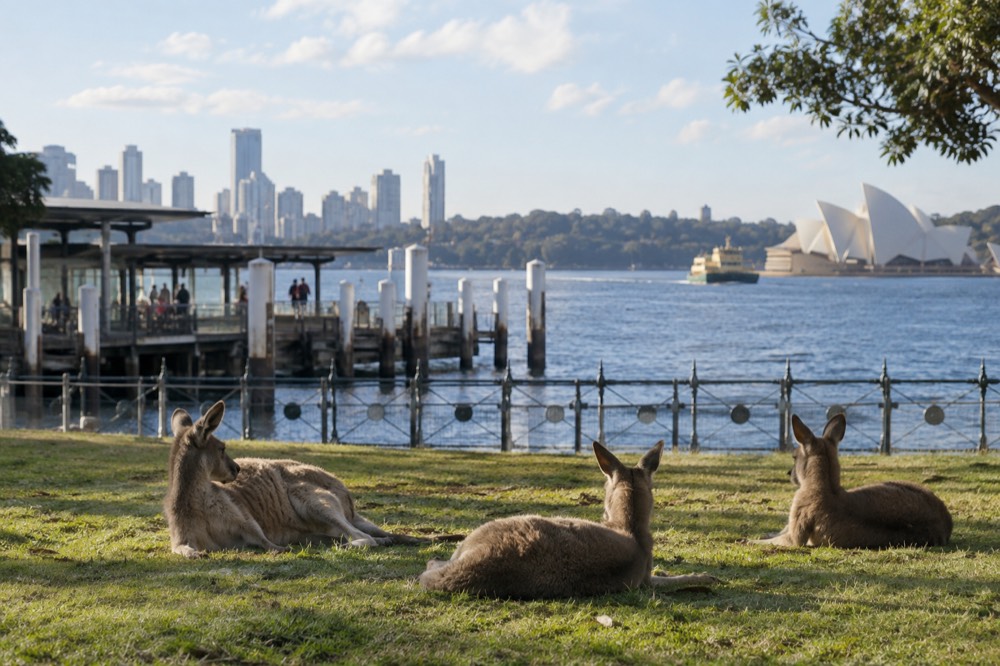
In the wild corner, the Southern Highlands day tour is the standout for a car-free visitor. It runs south into the ranges, stops where the animals actually are, and includes a full lunch, which matters when the nearest café is an hour away. Our can you see kangaroos near Sydney post covers the free and self-guided alternatives for anyone determined to do it on foot.
If wildlife is only part of your plan for the day, it is worth pairing the Southern Highlands run with a second, different kind of escape later in the week. The Blue Mountains all-inclusive tour that opened this guide is the natural companion, and the box below is the quick way to check whether your dates have seats before you build the rest of the itinerary around it.
How Do You Do the Hunter Valley Without a Driver?
You take a tour, or you accept a slower day. There is no train into the vineyards themselves, so the realistic options are a dedicated wine tour from the city, roughly 11 hours return with lunch included, or a train to a nearby centre plus a connecting bus or taxi, which eats most of your tasting time. For a single day, the tour is the only option that actually delivers the Hunter Valley.
The Hunter Valley is the one headline destination where the car-free gap is real. The wine country sits behind Cessnock and Pokolbin, and while the intercity network gets you into the region's edge, the cellar doors are spread across back roads with no meaningful bus network between them. A cyclist could manage a compact corner of Pokolbin, but tasting and riding do not mix responsibly.
The premium small-group tour below includes a two-course lunch and multiple cellar doors, which solves both the transport and the not-driving problems at once. Our Hunter Valley day trip guide compares the tour-first approach with an overnight stay, and the is the Hunter Valley better as a day trip or overnight post is the honest answer to that exact question.
If wine is the goal but a full Hunter day is too much, there is a middle path: a combined wildlife, waterfalls and wine day tour that samples the Blue Mountains and a vineyard region in a single 11-hour loop. It is a compromise, but a well-built one.
What About the Coast: Wollongong, Kiama and Jervis Bay?
Wollongong and Kiama are straightforward train trips, about 90 minutes and about two and a quarter hours respectively, and both are genuinely walkable from their stations. Jervis Bay is the exception: the train reaches Nowra but the beaches sit beyond it, so a day tour from the city, about 12 hours return with dolphin watching included, is the practical car-free answer.
The south coast is where the train earns its keep. The South Coast Line descends the escarpment south of Sydney, crosses the Sea Cliff Bridge stretch of the railway's road cousin, and delivers you to Wollongong's beachfront and then to the Kiama Blowhole, all for a capped Opal fare. The ride is scenic enough that the journey is part of the day out.
Jervis Bay's famous white sand at Hyams Beach is a different proposition. The bay sits inside a national park and marine reserve, the train stops short at Nowra, and the connecting buses are thin. The organised day trip below includes dolphin spotting on the bay and time on the beach, which is the whole point of going. Our Jervis Bay day trip guide covers the overnight alternative, which we recommend if you can spare the night.
For swimmers, one safety note applies to every beach on this coast: swim between the red and yellow flags at a patrolled beach during patrol hours, and stay out of the water for up to one day after heavy rain at ocean beaches, and up to three days at harbour and estuarine swim sites. The Beachwatch program publishes daily water quality grades, and patrol seasons and hours vary by beach, so check before you swim rather than assuming.
What Do the Fares and Caps Actually Add Up To?
A one-way intercity fare runs from A$8.28 at peak on the mid-distance bands to A$10.66 at peak on the longest ones, but the caps matter more than the fares: from Friday to Sunday and on public holidays, all your taps across train, bus, ferry and light rail are capped at A$9.65 for the day, and A$50 for the week. A weekend Blue Mountains round trip is therefore cheaper in fares than a single lunch in Katoomba.
The daily cap is the single most useful number in Sydney transport for a day tripper. On a Friday, Saturday, Sunday or NSW public holiday, you can ride trains, ferries, buses and light rail all day and the system stops charging at A$9.65. Monday to Thursday the cap is A$19.30. Off-peak fares, a 30% discount on trains, buses and light rail outside weekday peaks, stack on top of that for individual trips.
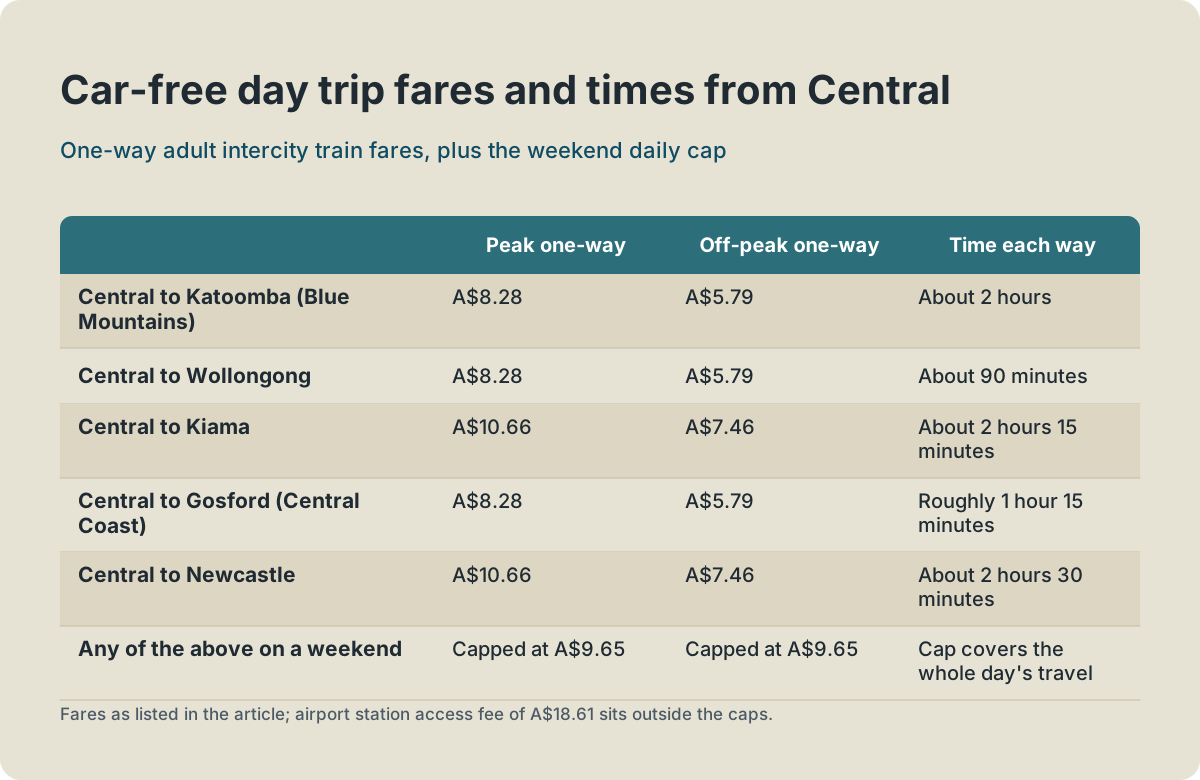
Two traps catch visitors. First, the airport station access fee of A$18.61 sits outside both caps, so if your day trip starts at the airport stations you pay it on top of the fare. Second, the privately operated Manly fast ferry accepts Opal through OpalPay but does not honour the caps or transfer discounts, unlike the public F1 ferry. Our are Sydney ferries included in the Opal daily cap post covers the ferry rules in detail.
| Trip | Peak one-way | Off-peak one-way | Notes |
|---|---|---|---|
| Central to Katoomba | A$8.28 | A$5.79 | Direct train, about 2 hours each way |
| Central to Wollongong | A$8.28 | A$5.79 | About 90 minutes each way |
| Central to Kiama | A$10.66 | A$7.46 | About 2 hours 15 minutes each way |
| Central to Gosford | A$8.28 | A$5.79 | Mid-distance band, direct train |
| Any of the above on a weekend | Capped at A$9.65 | Capped at A$9.65 | Cap covers the whole day's travel |
One more planning quirk worth knowing: the first Monday in August is the Bank Holiday, but it is not a public holiday for most workers, and attractions and transport run normally. Genuine public holidays, by contrast, trigger the cheaper A$9.65 cap, so a holiday Monday is one of the cheapest days to travel widely. The Sydney public holidays guide lists the full calendar.
When Is a Tour Better Than a Train, and When Is It a Waste?
A tour beats a train when the destination sits beyond the rail spine, when you have only one day and want three stops instead of one, or when the operator holds entries and lunch that would cost you more bought separately. A train beats a tour when you want to linger, when the weather is changeable, or when the destination is a single walkable town. Price is rarely the deciding factor, because capped fares and mid-range tours are closer than people assume.
The pattern across this guide is consistent. The Blue Mountains, Wollongong, Kiama, the Central Coast, Newcastle and the Royal National Park reward independence, because a train or ferry delivers you into the middle of somewhere walkable. The Hunter Valley, Jervis Bay and serious wildlife country reward a tour, because the interesting parts are scattered across roads.
Timing matters too. Sydney's climate is not what visitors assume: June is statistically the wettest month of the year, with a long-run average of 133.1 mm, wetter than any summer month, while August is the clearest, averaging 13.4 clear days. A wet-forecast day is a good day to hand the driving and the decisions to a tour operator, and our Sydney rainy day itinerary covers the in-town fallback. For the full month-by-month picture, the Bureau of Meteorology's Sydney climate averages are the primary source we use.
| Choose the train when | Choose a tour when |
|---|---|
| The destination is on the rail line | The destination sits beyond it |
| You want to set your own pace | You have exactly one day and three must-sees |
| The forecast is settled | The forecast is changeable |
| You are happy planning connections | You would rather not plan at all |
| Budget is the priority | Entries, lunch and transfers are bundled |
Whatever you choose, book the tour side early: the best small-group departures, especially the Blue Mountains and wildlife runs, sell out on weekends and school holidays first, and our how far in advance to book Sydney tours post has the timing detail.
Common Questions About Day Trips from Sydney Without a Car
Can you do the Blue Mountains without a car?
Yes, easily. A direct intercity train runs from Central to Katoomba in about two hours, and the town, the Explorer bus link and the Scenic World cableway cover the main lookouts and attractions. Park entry is free outside the Glenbrook area, so the only costs are fares and any paid attractions.
Is the Hunter Valley possible without a car?
Only as a tour or as an overnight trip with a local transfer. There is no train into the vineyards, and the cellar doors are spread across back roads. A wine tour from the city, about 11 hours return with lunch included, is the practical single-day answer.
Do Opal caps apply to intercity day trips?
Yes. Intercity trains to the Blue Mountains, Wollongong, Kiama and the Central Coast are part of the Opal network, so the daily caps apply: A$9.65 from Friday to Sunday and on public holidays, A$19.30 Monday to Thursday, A$50 a week. The airport station access fee sits outside these caps.
What is the cheapest day trip from Sydney without a car?
On a weekend or public holiday, almost any train trip is capped at A$9.65 for the whole day. Wollongong, about 90 minutes away with a beach and a free coastal walk at the end of it, is arguably the best value of all. The Royal National Park via the Cronulla-to-Bundeena ferry is another low-cost favourite.
Can you get to Jervis Bay by public transport?
Partly. The train reaches Nowra, but the bay and Hyams Beach sit beyond it with thin connecting buses. For a single day, an organised tour from the city, about 12 hours return with dolphin watching and beach time, is the realistic car-free option.
Do you need to book Sydney day tours in advance?
For the Blue Mountains and wildlife tours, yes, especially on weekends, school holidays and clear-weather days after a wet spell. Small-group departures are capacity-limited and the popular ones sell out days ahead. Train travel needs no booking at all, just tap on.
For everything else the city itself offers once you are back, the Sydney Travel Guide homepage is the full index.