How Long Is the Bondi to Coogee Walk?
The Bondi to Coogee coastal walk takes two to three hours of walking across about six kilometres. Here is a section-by-section breakdown, swimming safety notes and how to get back.
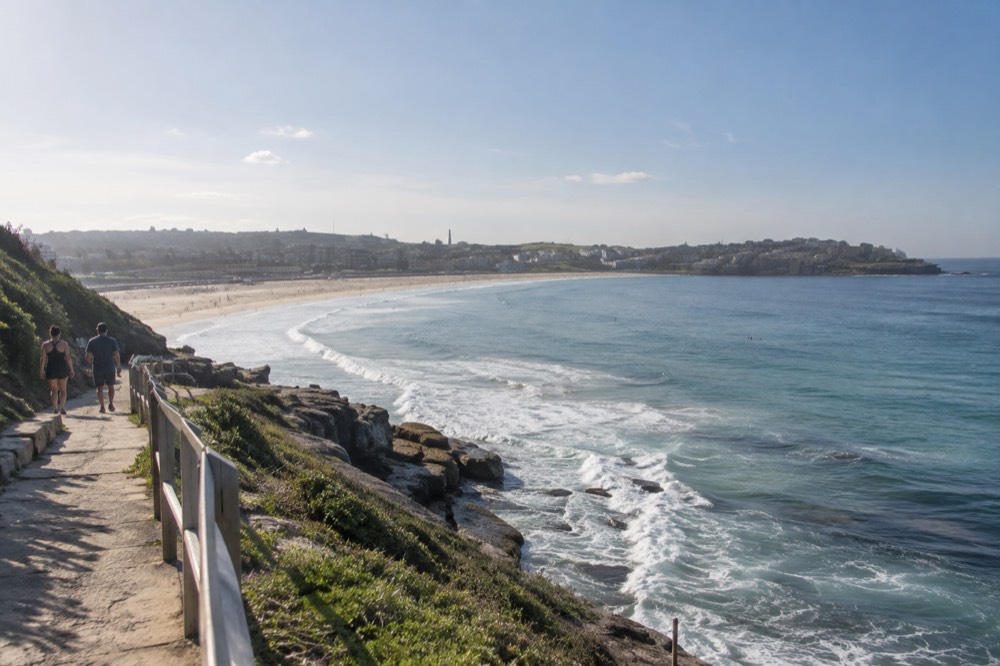
Sydney's most famous seaside walk is not one long beach promenade. It is a chain of clifftop paths, staircases and parkland linking five beaches between Bondi and Coogee, and the honest answer to how much time it eats depends almost entirely on how often you stop. The full route is a manageable morning for anyone with ordinary fitness, but it is also the single easiest walk in Sydney to stretch into an entire day, because almost every section ends at a beach, an ocean pool or a cafe that argues for staying longer.
How Long Is the Bondi to Coogee Walk?
The Bondi to Coogee walk covers roughly six kilometres one way and takes about two hours of pure walking at a steady pace. Most visitors need two and a half to three hours once you add photos, ocean-pool stops and a swim, and a relaxed half day if you lunch at one of the beaches along the way. Walking back doubles the distance, so almost everyone returns by bus.
The two-hour figure assumes you keep moving. In practice almost nobody does. The path leaves Bondi Beach via the Icebergs end, climbs over McKenzie's Point, drops into Tamarama, rises again past the cemetery headland to Bronte, then works its way south through Clovelly and Gordon's Bay before the final descent into Coogee. Each of those transitions is a short, steepish staircase section, and each one deposits you somewhere you will want to pause.
Direction matters less than people expect. The path is equally walkable both ways, though starting at Bondi means the majority of your walking is done before the midday sun is at its strongest, and the buses back to the city run more frequently from Coogee than the reverse for most of the day. If you are timing a visit around light rather than buses, the clifftops face east, so morning is the photographer's window.
One planning note that saves real time: check the weather before committing. The long-run averages from the Bureau of Meteorology show June is actually Sydney's wettest month, at 133.1 mm of mean rainfall, wetter than any summer month. A wet day does not make the walk impossible, but it does make the sandstone steps slippery and the views grey.
How Far Is the Bondi to Coogee Walk in Kilometres?
The route is about six kilometres end to end, which is why walkers of average fitness finish it comfortably in a morning. It breaks into five natural sections of one to one and a half kilometres each, separated by the beaches at Tamarama, Bronte, Clovelly and Gordon's Bay. Nothing on the path is flat, but no single climb lasts more than a few minutes.
Six kilometres sounds trivial, and on a footpath it would be. On this route the distance is punctuated by stairs, so the honest measure is time on feet rather than distance. The table below breaks the walk into its natural legs with typical walking times, not including stops. Treat those times as a floor, not a plan.
| Section | Approx. distance | Typical walking time | What you pass |
|---|---|---|---|
| Bondi Beach to Tamarama | about 1.5 km | 20-25 min | Bondi Icebergs pool, McKenzie's Point lookouts |
| Tamarama to Bronte | about 1 km | 10-15 min | Tamarama Beach, Bronte's ocean pool and park |
| Bronte to Clovelly | about 1.5 km | 20-25 min | Waverley Cemetery clifftop path |
| Clovelly to Gordon's Bay | about 1 km | 10-15 min | Clovelly Bay, the boat ramp at Gordon's Bay |
| Gordon's Bay to Coogee | about 1 km | 15 min | Dolphin Point, Coogee's parks and beach |
The cemetery stretch between Bronte and Clovelly is the part people remember longest: the path runs along the clifftop above Waverley Cemetery, with white monuments on one side and open ocean on the other. It is also one of the widest and most even sections of the whole walk, a good place to make up time if you are running behind.
If six kilometres sounds like more than your group wants, there is a graceful shortcut. Walk Bondi to Bronte, roughly three kilometres, and catch a bus back from Bronte. You still get the Icebergs, the two best lookouts and an ocean pool, in about half the time. Our full Bondi to Coogee coastal walk guide covers the route in detail, and our broader round-up of Sydney's best coastal walks lists alternatives if this one is crowded.
How Hard Is the Bondi to Coogee Walk?
The walk is easy to moderate. There are no technical sections, no scrambling and no exposure, but there are stairs at every beach transition, so it is not a flat stroll and it is not fully step-free. Reasonable shoes matter more than fitness: the path is paved or boardwalk for almost its entire length, and ordinary trainers are fine. Allow extra time if anyone in your group is slow on stairs.
The honest difficulty answer is that the walk punishes footwear choices, not fitness levels. Thongs are common on this path and regularly the reason someone turns around at Tamarama. The sandstone steps can be polished smooth, and after rain they are genuinely slick. A shoe with grip turns the whole route into a straightforward walk.
There is very little shade anywhere on the path, which matters more than the stairs for most visitors. The UV index in Sydney reaches extreme levels of 11 or more in summer, and protection is advised whenever the index hits 3, which it does for most of the year even outside the December to February summer months. Hat, sunscreen and water are not optional extras here; the only reliable shade is at the beach ends, and a mid-walk coffee stop at Bronte is the closest thing to a sheltered rest.
For families, the walk is doable with school-aged children in about three hours with stops. With a toddler in a carrier it is still possible, but our Sydney with a toddler guide suggests shorter alternatives, because the stair sections make a pram impractical for the full route.
Which Beaches and Ocean Pools Does the Walk Pass?
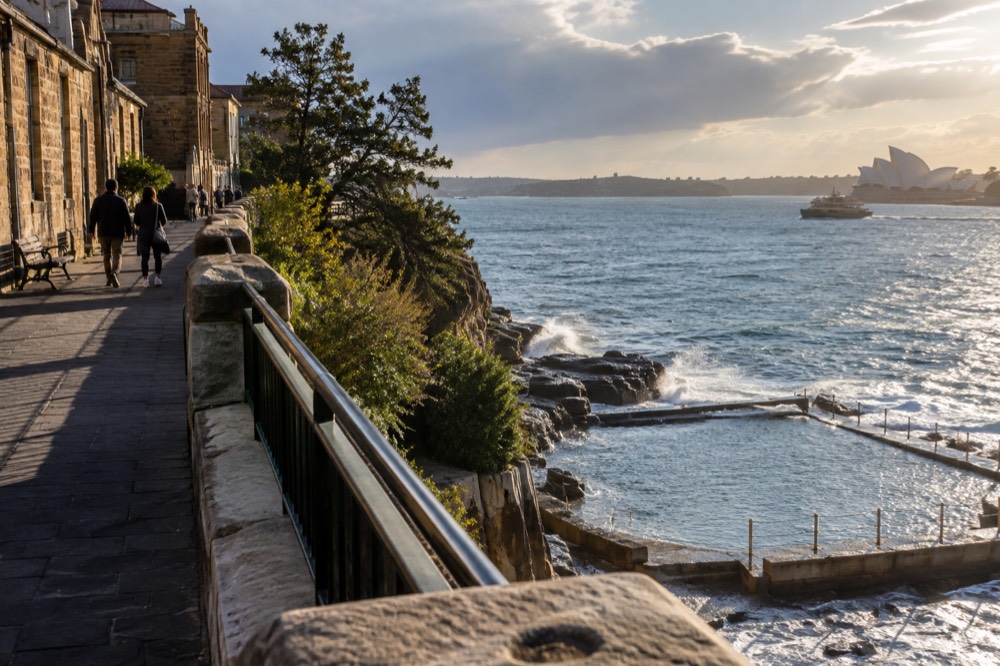
The walk links five swim spots: Bondi, Tamarama, Bronte, Clovelly and Coogee, plus Gordon's Bay as a snorkelling nook. Three of them, Bondi, Bronte and Coogee, have ocean pools, and Bronte's pool is free to swim in, while Bondi Icebergs is a club-run pool with an access fee. Tamarama is the smallest and most photographed beach on the route.
The pools deserve a specific mention because they change what the walk is. Bronte Ocean Pool is council-run and free, cleaned weekly, and sits right where the path reaches the park. Bondi Icebergs at the very start is the famous one, the 50-metre pool photographed from above in half the travel posts about Sydney ever published, and it is club-managed with a fee, not a free public pool. Clovelly is a different thing again: a narrow, sheltered bay that functions as a natural ocean pool, calm enough that it is one of Sydney's most popular learn-to-snorkel spots. The wider set of guides lives on Sydney Travel Guide.
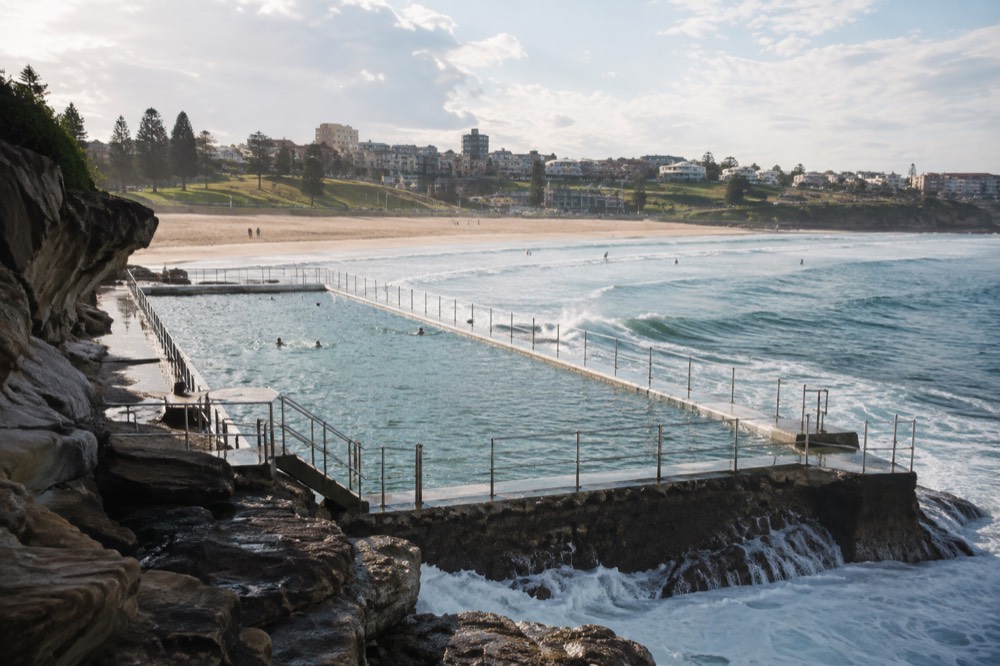
If swimming is part of your plan, budget the time honestly. A swim at Bronte plus drying off easily adds an hour to the walk, and that is before anyone orders a coffee. Most locals do the walk as a swim-transport system: walk one section, swim, walk the next.
The individual beaches each have their own character and their own guide on this site if you want to go deeper: Bondi Beach for the full big-beach experience, Coogee Beach for the calmer, more family-oriented end, and Shelly Beach Manly if you decide the whole east is too busy and want the northern alternative instead.
When Is the Best Time of Day to Do the Walk?
Start between 7am and 9am. The path faces east, so morning light is the best light, the summer heat has not built yet, and you finish before the midday sun is directly overhead on a shadeless route. In the October to April daylight saving months, an early start also beats the crowds that thicken from late morning, especially on weekends.
Sunrise is the quietest and most spectacular window, and it is the one time of day the walk feels almost private. If the idea of clifftops at dawn appeals but six kilometres before breakfast does not, there is a water-based alternative that captures the same light: the Harbour Sunrise Kayak Tour paddles Sydney Harbour in the hour most visitors sleep through, and pairs naturally with a coastal walk on the following morning.
The counterintuitive fact worth knowing before you pick a month: Sydney's clearest skies are in late winter, not summer. The Bureau of Meteorology's long-run records show August averages 13.4 clear days, the most of any month, while February, the middle of peak season, averages just 5.3, the fewest. Peak season here is statistically the cloudiest time of year. A winter-morning walk in August is often brighter than a February one, and the path is far quieter.
Where Can You Swim Safely Along the Route?
Swim only at patrolled beaches and only between the red and yellow flags, during patrol hours. On this route, Bondi, Bronte, Tamarama and Coogee are the patrolled beaches, and the Waverley beaches are patrolled year-round, which is unusual: hours run 6am to 7pm from October to April and 7am to 5:30pm from May to September. Gordon's Bay and Clovelly have no flags; treat them as lookouts, not swim stops, unless you know the conditions.
Rip currents are the number one hazard on this coast, and the official advice from Surf Life Saving Australia's Beachsafe program is unambiguous: the safest place to swim is between the red and yellow flags at a patrolled beach during patrol hours. If you are caught in a rip, the official guidance is to stay calm and conserve energy, raise an arm and call for help, float with the current which may return you to a sandbank, or swim parallel to the beach toward breaking waves. Never try to swim directly back to shore against the current.
Two more official notes that most guides skip. The NSW Beachwatch program grades swim sites on water quality, and its standing advice is to stay out of the water while it is raining and for up to one day after heavy rain at ocean beaches, and for up to three days after heavy rain at harbour and estuarine sites. After a June downpour, that postcard-perfect surf at Tamarama is not a good idea. And bluebottles are common in the warmer months and after onshore winds: do not touch them on the sand or in the water, and if stung, leave the water, remove tentacles with seawater rather than bare hands, and immerse the sting in hot water around 45 °C for up to 20 minutes.
The ocean pools change the safety picture for the better. Bronte's free pool and the sheltered bay at Clovelly give you a place to get in the water on days when the surf is rough or the flags are not yet up, though pools can still close in big swell.
How Do You Get Back from Coogee?
Buses run from Coogee back toward the city and to Bondi Junction regularly through the day, and the walk is one-way for almost everyone. With an Opal card or a contactless credit card the adult daily fare is capped, at $9.65 on Fridays, weekends and public holidays and $19.30 Monday to Thursday, so the return trip is cheap. There is no train at Coogee; the bus is the practical option.
The transport detail worth knowing before you tap: a contactless card or phone wallet is charged exactly the same as an Adult Opal card and receives every benefit, including the caps. The one trap on this route is none at all, since the buses are all Opal-network services, but our Opal card guide for visitors covers the caps and the off-peak discount in full if you are building a bigger day around the walk.
If you would rather not retrace any ground at all, the other direction works too: bus to Coogee first, walk north, and finish at Bondi, where the cafes and the Icebergs make the strongest case for the walk ending there at lunchtime. Either way, plan the walk one-way and let the bus carry the return. Six kilometres of clifftop is enough for one morning; twelve is a different outing entirely.
Common Questions About the Bondi to Coogee Walk
How long is the Bondi to Coogee walk?
About two hours of actual walking over roughly six kilometres, two and a half to three hours with normal photo and swim stops, and a relaxed half day if you lunch along the way. Almost everyone walks it one way and buses back.
Is the Bondi to Coogee walk hard?
It is an easy to moderate walk. The path is paved or boardwalk almost throughout, but every beach transition involves stairs, so it is not step-free and grip on your shoes matters, especially after rain.
Can you do the Bondi to Coogee walk with a pram?
Not the full route comfortably. The stair sections between beaches make a pram impractical end to end. The Bondi to Bronte half is the more realistic option with small children, or use a carrier.
Which way is better, Bondi to Coogee or Coogee to Bondi?
The path works both ways. Starting at Bondi puts most of your walking in the cooler morning hours and finishes you at Coogee, where buses back to the city run frequently. Starting at Coogee finishes you at Bondi's cafes at lunchtime.
Are there toilets and cafes along the Bondi to Coogee walk?
Yes, at both ends and at most beaches between. Tamarama, Bronte, Clovelly and Coogee all have public facilities and nearby cafes, so you never go more than about 20 minutes without a stop.
Can you swim on the Bondi to Coogee walk in winter?
Yes. Bondi, Bronte, Tamarama and Coogee are patrolled year-round, with winter patrol hours of 7am to 5:30pm on the Waverley beaches. Swim between the flags during patrol hours, and remember the ocean pools, including free Bronte pool, are an alternative when the surf is rough.